

Opening the Cold Case
The Savage Family Mysteries — Part 1 of 5, in a Substack Exchange with Lisa Rex

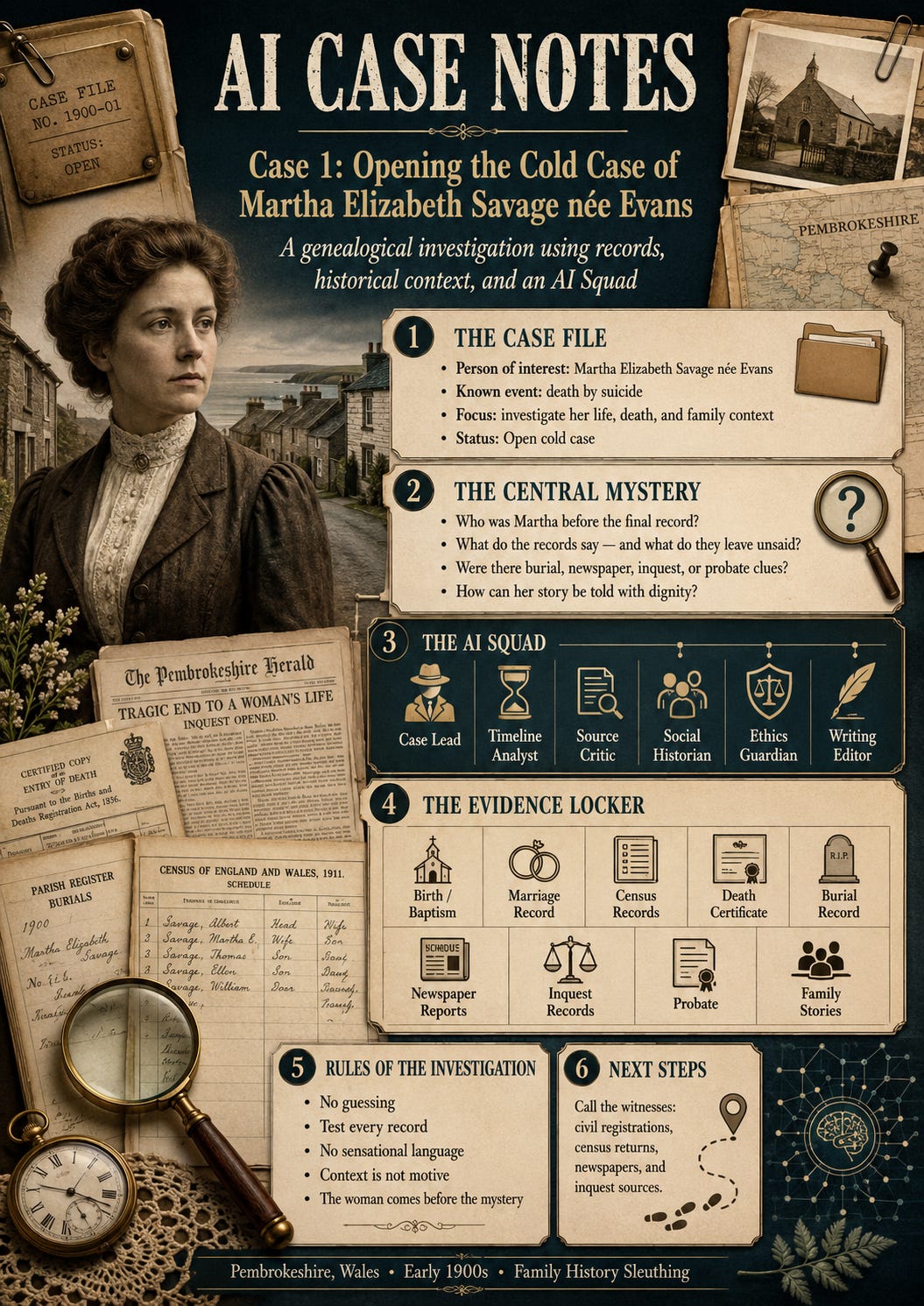
Every family historian eventually inherits a cold case.
Mine begins with Martha Elizabeth Savage née Evans, a woman whose life ended in tragedy and whose story now asks to be handled with care, evidence, and compassion. This is not a case of crime in the usual sense. There is no villain to expose, no neat solution to deliver, no dramatic confession waiting in the archive.
Instead, this is a quieter kind of investigation.
It is the search for a woman behind a record of death. It is the attempt to understand what can be known, what remains unknown, and how a genealogist can investigate a painful family history without turning suffering into spectacle.
This first entry in my new AI Case Notes series opens the file.
Case File 1: Remembering Martha Elizabeth Savage
Person of Interest: Martha Elizabeth Savage née Evans
Known events under investigation: Marriage in 1899, birth of son in 1904, admission to Carmarthenshire Lunatic Asylum in 1907, death by suicide in 1918.
Research focus: To investigate Martha’s life, death, family circumstances, and historical context using genealogical evidence, careful source analysis, and AI-assisted research methods.
Case status: Open
Emotional classification: Sensitive family history
At this stage, I am treating every detail as evidence to be tested, not a story to be embellished. Where a record confirms a fact, I will say so. Where a detail is uncertain, I will mark it as unknown. Where the evidence is incomplete, I will resist the temptation to fill the silence with imagination.
That is the first rule of this investigation: Martha deserves truth, not invention.
The Central Mystery
The central question is not simply “How did Martha die?”
A death record answers that in a formal sense. But family history asks wider, more human questions:
Who was Martha before the final record?
What family, social, economic, and emotional pressures surrounded her?
What do the surviving records say?
What do they refuse to say?
Where are the newspaper reports, inquest records, burial records, institutional records, or family documents that might add context?
How can I write about her life and death with dignity?
This case is not about reducing Martha to the manner of her death. It is about restoring her place in the family story.
The Case Lead: Carole McCulloch
As the AI-skilled genealogist, I aim to keep the investigation focused – to hold the central research question in view and prevent the story from wandering into speculation. This case study will be referenced in my online courseware as an example of the AI Squad approach.
Case Lead prompt:
“Act as a genealogical case manager. Help me define the research question, separate known facts from assumptions, and identify the next best research steps.”
The AI Squad
For this investigation, I will be working with what I call my AI Squad — not as a replacement for genealogical methods, but as a set of research assistants, each with a clearly defined role.
1. The Timeline Analyst: Gemini
The Timeline Analyst builds a chronological reconstruction of Martha’s life from the records. This helps identify gaps, contradictions, and turning points. The output can be structured as a data table.
Timeline analyst prompt:
“Using only the facts I provide, create a chronological timeline. Include columns for date, event, place, source, evidence value, and unresolved questions.”
2. The Source Critic and Evidence Locker: NotebookLM
The source critic interrogates each record as a witness. Who created it? Why? Who supplied the information? How reliable is it? The output can be structured as a Report.
Source critic prompt:
“Analyse this record as genealogical evidence. Identify the informant where known, assess reliability, and explain what the record proves, suggests, or does not prove.”
3. The Social Historian: Perplexity
The social historian helps place Martha in her historical setting. This may include women’s lives, marriage, motherhood, health, bereavement, housing, religion, work, and social expectations. The output can be structured as a Locality Guide.
Social historian prompt:
“Provide historical context for this place and period, but do not infer Martha’s personal motives unless supported by evidence.”
4. The Illustrators: Gemini or ChatGPT
Gemini can create illustrations for scenes to be incorporated into the written story. I will prompt the creation of images from the context of the story using engineered prompts. Prompt Cowboy helps structure strong descriptive prompts for these.
Illustrator prompt:
“Create an infographic that illustrates this first scene in my story. [paste description] Use a detective genealogist style with appropriate icons and photo realistic imagery related to the early 1900s in Pembrokeshire, Wales.”
Note: Chat GPT creates the opening images for each of my posts in this series.
5. The Writing Editors: Claude Chat or Cowork
The writing editor helps shape the final story so it reads like a detective case study while remaining accurate and respectful.
Writing editor prompt:
“Revise this genealogy case study in the style of thoughtful historical non-fiction with a light detective structure. Do not add facts.”
6. The Prompt Engineer: Prompt Cowboy
Prompt Cowboy enables the creation of strong, meaningful prompts from your initial input. These can be stored in the folders of the Prompt Cowboy Library.
The Evidence Locker: NotebookLM
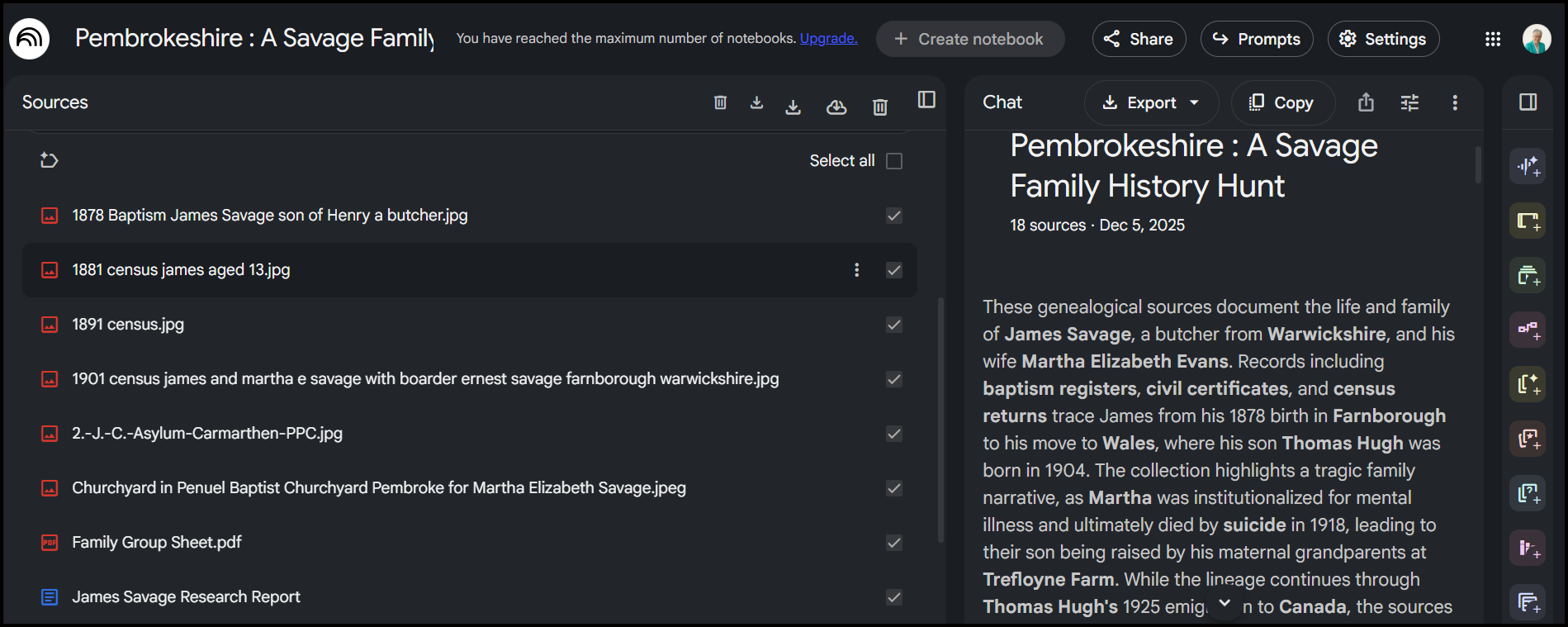
The next task is to gather the evidence already known and place it into a structured case file. I have set up the Pembrokeshire: A Savage Family History Hunt Notebook as the evidence locker.
The evidence locker may include the following items and more as the research continues.
Birth or baptism record, marriage record, census records, death certificate, burial record, newspaper reports, coroner or inquest records, probate or administration, family stories or notes, and family group sheets.
These are uploaded as ‘Sources’ see the left-hand panel of the ‘Notebook’.
The Rules of the Investigation
Before I begin, I need rules.
Rule 1: No guessing: If the evidence does not tell me something, I will say unknown.
Rule 2: No single-record conclusions: One record may provide a clue, but the case will rest on a pattern of evidence.
Rule 3: No sensational language: Martha’s death will not be treated as drama. The detective structure is a storytelling device, not an excuse to turn grief into entertainment.
Rule 4: Context is not motive. Historical context may help me understand the world around Martha, but it cannot tell me exactly what she felt unless a source says so.
Rule 5: The woman comes before the mystery: Martha was not a “suicide case”. She was a daughter, a wife, a mother, a neighbour, a worker, a churchgoer, a friend, or a member of a community. Some of those roles may be documented. Some may remain unknown.
Opening Questions
These are the questions I will carry into the next stage of the investigation:
What are the earliest confirmed records for Martha Elizabeth Evans?
When and where did she become Martha Elizabeth Savage?
Who was present at key life events as witnesses, informants, neighbours, or household members?
What does the death certificate actually say?
Was there an inquest?
Did newspapers report the death?
Where was Martha buried?
What family members were nearby at the time?
What was happening socially, economically, and locally around her?
Which parts of her story can be proved, and which must remain unknown?
Case Note: Why AI Belongs in This Investigation
AI will not solve this case for me.
It cannot replace original records. It cannot decide truth from imagination. It cannot know Martha’s mind. It cannot turn an unsourced family story into evidence.
But it can help me think.
It can help me organise a timeline, test a hypothesis, generate search strategies, compare conflicting records, ask better questions, and write with more care. It can act as a research assistant, a sceptical colleague, a social historian, and an editor—provided I remain the genealogist in charge.
That is the heart of this series.
Not “AI tells the story.” But rather:
AI helps me investigate. Evidence helps me decide. Ethics helps me write.
Where the Case Goes Next
In the next instalment of The Savage Family Mysteries, Part 2 of 5, I will begin calling the witnesses.
The first witnesses will be the records themselves: civil registrations, census returns, marriage evidence, death documentation, and any surviving newspaper or inquest material. I will ask what each source proves, what it merely suggests, and where it may mislead me.
For now, the case file is open.
Martha Elizabeth Savage, née Evans, has stepped out of the shadows of a single tragic record and into the fuller work of family history investigation.
The trail begins here.
Lisa Rex of Ancestor Audit is exploring her own research challenge case across the same five weeks. You can follow along at Lisa’s AI Case Notes.
We will be posting on Tuesdays and Thursdays throughout July, and we’re both excited to explore where our Substack Exchange will take us.
I joined substack recently to promote my debut novel coming out soon! I would love for you to subscribe and support me on my journey.
Open and Shut is a detective murder mystery that follows Detective Calvin Russell as he investigates the murder of Sylvia Cobb. While the evidence seems to point squarely at her husband, Calvin begins to suspect there's more to the story as buried secrets begin to surface throughout the neighborhood.
Fascinating project