

Redrawing the Border
The Savage Family Mysteries — Part 2 of 5, in a Substack Exchange with Lisa Rex

The Detective Framework · This week's hero: Gemini
The first question: What are the earliest confirmed records for Martha Elizabeth Evans?
This question was one of many in the Case File for Martha, and you can read the first episode here: Opening the Cold Case
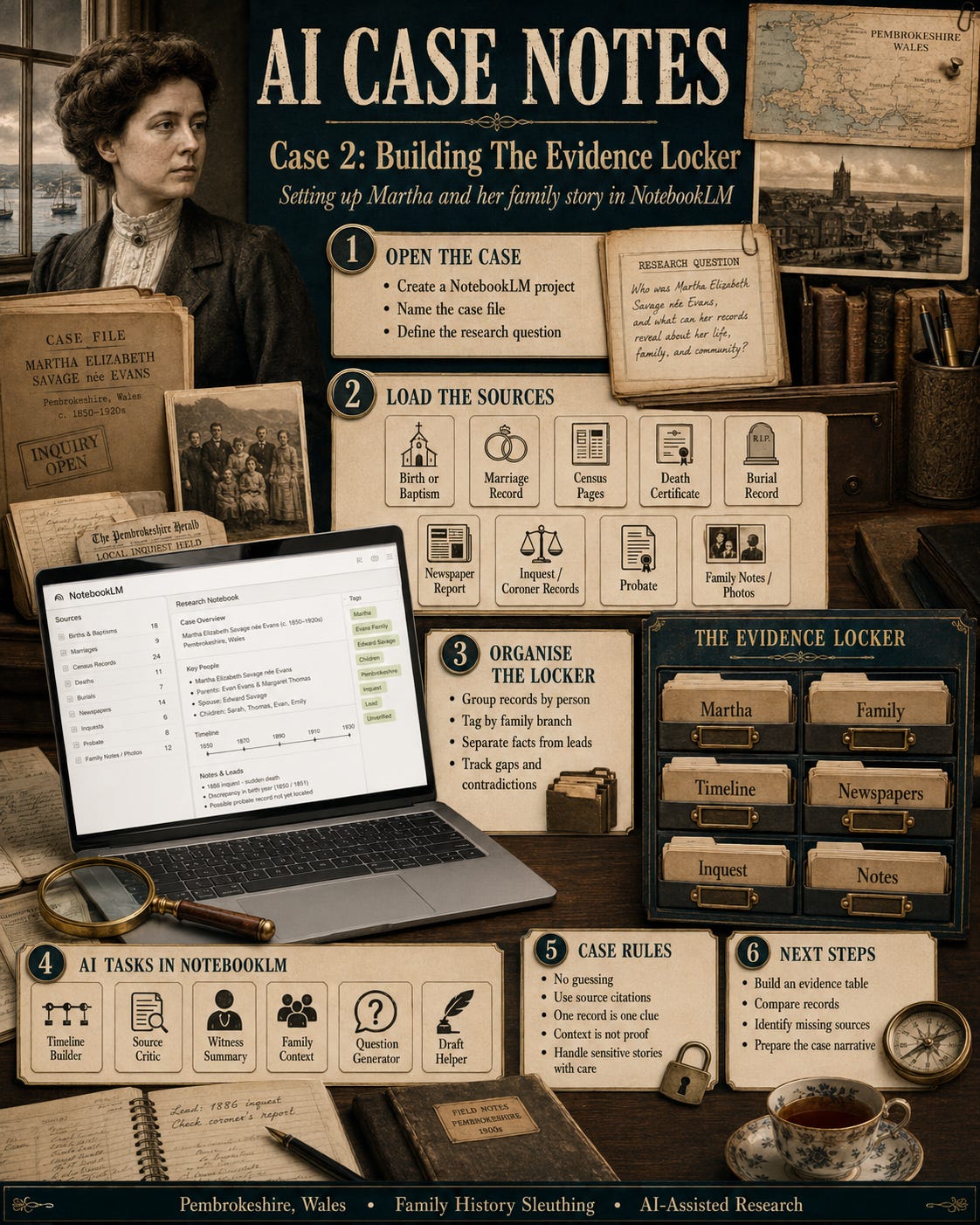
Every family historian knows the sinking feeling. You have them in 1881. You have them again in 1901. But 1891? Gone. No matter how you spell the surname, no matter how wide you cast the net, the family are not where they ought to be.
That was my Evans family. Present, accounted for, respectable — and then, for one census night in 1891, seemingly vanished from the face of Worcestershire - or was it Herefordshire?
Here’s how I found them again. And – the part that matters for your own brick walls – how the tool did the heavy lifting so I didn’t have to.
The Evans family moved between Wales and England, following demand for dairy farming management between 1871 and 1921. Their various locations were enumerated well in the Welsh census records, but I hit a brick wall when trying to locate them in the English census records for 1891. My goal was to fill in the details of the life of Martha Elizabeth Evans in the decade between 1891 and 1901; I needed that census record.
It was frustrating!
🔍 The Mystery
The next question: Where was the Evans family on census night, 5 April 1891?
I expected to find them in Bromyard, Herefordshire — the market town where the family was located. But the 1891 return for Bromyard didn’t hold them. Not misfiled, not mistranscribed under a mangled surname — genuinely not there. I had noted that the birthplace for several of the younger children of the family was listed as either ‘Hope Farm’ or ‘The Hope’, but in some the registration district was written as Bromyard and in others as Worcester.
Confusing!
When a family goes missing from a single census but reappears cleanly on either side of it, the temptation is to blame the indexing. Sometimes that’s right. This time it wasn’t. The problem wasn’t the transcription. It was the map.
I needed to learn the geography of this border region - I was totally unaware of the terrain or of the distances between the villages.
🧩 The Clues
Bromyard sits close to the Herefordshire–Worcestershire border, and that border is the whole story. Registration and enumeration districts along county boundaries were redrawn between census years, so a household could stay in the same house and still shift — on paper — into a different enumeration district, and sometimes a different county’s records entirely.
That was the thread worth pulling: not “how is the surname spelled?” but “which district was this address actually enumerated under in 1891?”
The clue pointed away from Bromyard proper and toward the parishes on the county edge – the Herefordshire/Worcestershire fringe where Edvin Loach lies.
🕵️ The Lead AI Followed — Gemini Gathers
This is where this episode’s squad member earned its place.
I asked Gemini to do what it does best: wide-net scouting on record availability and jurisdiction – which counties and registration districts covered the Bromyard border parishes in 1891 and how those enumerations had changed since 1881.
One tool. One job. Gemini didn’t find my family — census sites hold the records, not Gemini. What it did was narrow the ground: it identified the border counties and the shifting district lines, so I knew where to point the actual search. It turned a hopeless “They’re not in Bromyard” into a specific, testable “Then check the Edvin Loach enumeration on the Herefordshire side.”
Here is my prompt (I added an image of the 1901 census record):
Here's the 1901 census for the Evans family living in Weedon Lois. Please transcribe, analyse and provide insights into how to find the missing 1891 census for the Evans family.
This is part of the response from Gemini, which gave me the path to follow:
The 1901 census for Weedon Lois, Northamptonshire, reveals that between 1886 and 1892, the Evans family relocated to “Hope Farm” in Worcestershire, providing the exact geographic target needed to locate their missing 1891 census return.
Historical Context & Migration Patterns
Agricultural Mobility: The document records a significant, multi-county migration pattern common among successful late-Victorian tenant farmers moving up the agricultural ladder. The family moved from Pembrokeshire, Wales, to Worcestershire, England, between 1881 and 1886. They managed a property also named “Hope Farm” in Worcestershire for roughly a decade before migrating to Weedon Lois, Northamptonshire, by 1897.
Family Dairy Economy: The entire family unit ran a specialised dairy operation. Maria is listed as a dairy manageress, Eunice as an indoor dairy maid, and 15-year-old Ada as an outdoor dairy maid. This emphasises that their farm placements were chosen specifically to facilitate commercial dairy production.
1891 UK Census (Worcestershire Property Search): Address-based search for “Hope Farm” within Worcestershire parishes to identify the occupants regardless of surname spelling.
An address-based search - thanks, Gemini, for helping me THINK!
Address-Based 1891 Census Search
Exact Search Terms: Street/Property Name: Hope Farm, County: Worcestershire, in the 1891 census search criteria.
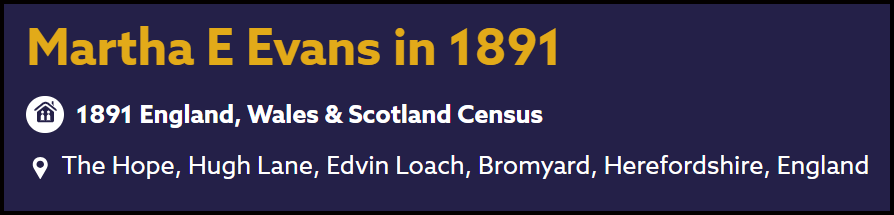
With the county and district identified, I ran the confirming search on FindMyPast — and there they were.
Note: I had tried this on Ancestry with no luck and was reluctant to take out another subscription at FMP. However, they offer a monthly subscription, so I paid for a month, and immediately, the screen displayed the missing 1891 census.
✅ The Reveal
The 1891 census (via FindMyPast) placed the entire Evans family at Hope Farm in the parish of Edvin Loach — the property often written simply as “The Hope” — in [Hugh] Lane (the handwriting reads Hugh, though it may be [High] Lane?).
Success is sweet!
They hadn’t moved. They hadn’t vanished. They were exactly where a farming family should be — at home on the farm, with several servants in the household — sitting quietly on the Herefordshire border, enumerated just across the line from where I’d been looking.
With both pages of the 1891 census now in hand, I headed back to Gemini for a transcription. The output was exported as a .csv file and added directly into the Google spreadsheet holding all the census data for the Evans and Savage Families.
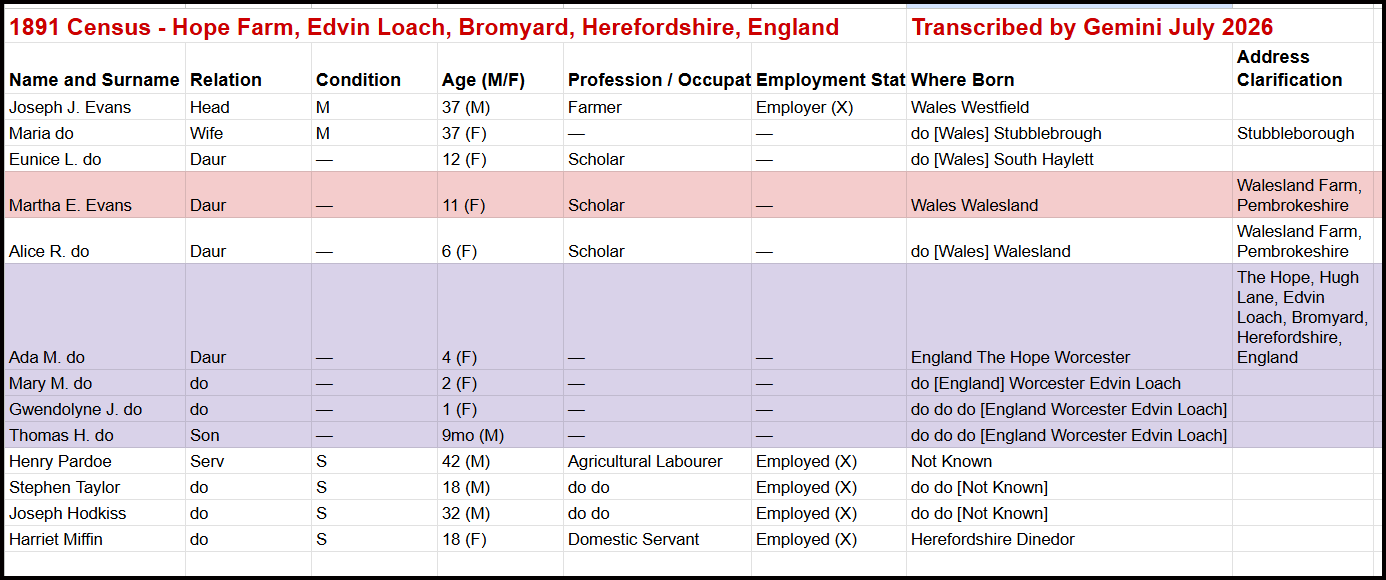
What the record proves: the whole family, in one place, on census night 1891, at a named property with a working household.
What it doesn’t (yet): the precise reading of [Hugh] / [High] Lane stays flagged until I check it against a parish map or the original schedule. I would rather carry an honest one than record a tidy guess.
🧭 The Takeaway
When a family disappears for a single census, run through this before you blame the spelling:
Check the map before the surname. Border-county families move on paper without moving house. Redrawn registration and enumeration districts hide people in plain sight.
Let each tool do one job. Gemini’s job here wasn’t discovery — it was jurisdiction. Knowing which county and district to search is often the difference between a blank result and a match.
Confirm on the record. AI narrows the ground; the census image proves the case. Gemini pointed; FindMyPast delivered.
One tool. One job. One genuine win — a family of Evanses restored to Hope Farm, right where they’d always been.
Where has a redrawn boundary hidden one of your families? Reply and tell me which census defeated you!

The AI Squad for this series:
Gemini — gathers & reads: record availability, jurisdiction, place-names, boundaries, image work and record transcriptions
PromptCowboy — prompts: generating and sharpening the prompts that drive the other tools
Claude (Chat + Cowork) crafts reasoning through the puzzle and shapes the narrative
NotebookLM — grounds: the source-anchored, citable hub for the series
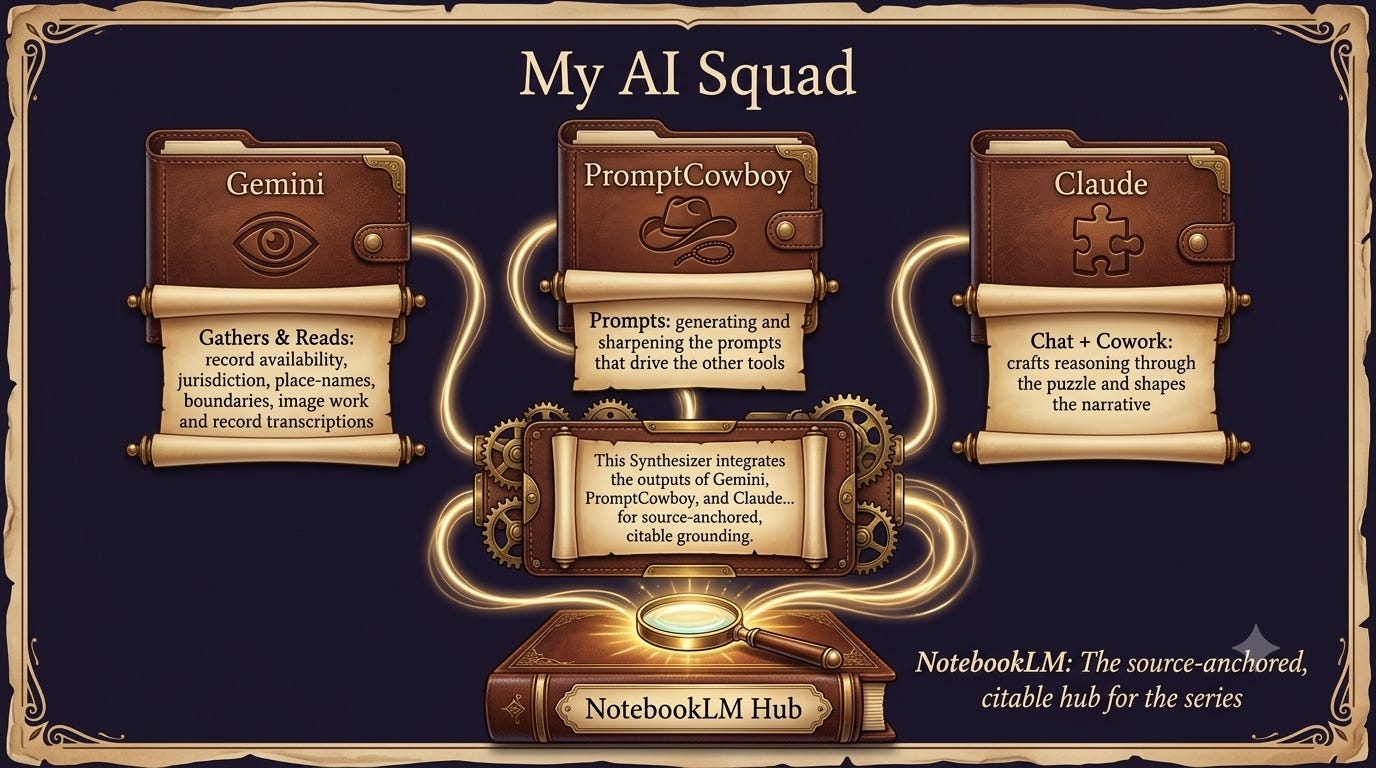
Now to add everything into the Evidence Locker!
The final step in Gemini was to summarise everything we had accomplished (from a rather long conversation) and create an updated genealogical dossier for the Evans and Savage families. This was exported as a Google Doc and added to the Notebook for this Case in NotebookLM.
Integrating the newly transcribed 1891 census data into the master dossier updated the family’s migration path, established their socio-economic standing at “The Hope”, and provided exact local birthplace anchors for NotebookLM ingestion.
I was ready for the next steps in NotebookLM!
Stay tuned for the next episode of Cold Case: Savage Family Mysteries! Lisa Rex of Ancestor Audit is exploring her own research challenge case across the same five weeks. You can follow along at Lisa’s AI Case Notes.
We will be posting on Tuesdays and Thursdays throughout July, and we’re both excited to explore where our Substack Exchange will take us.