


AI Case Notes — The Evans / Savage Family Mysteries · Post 5 of 5
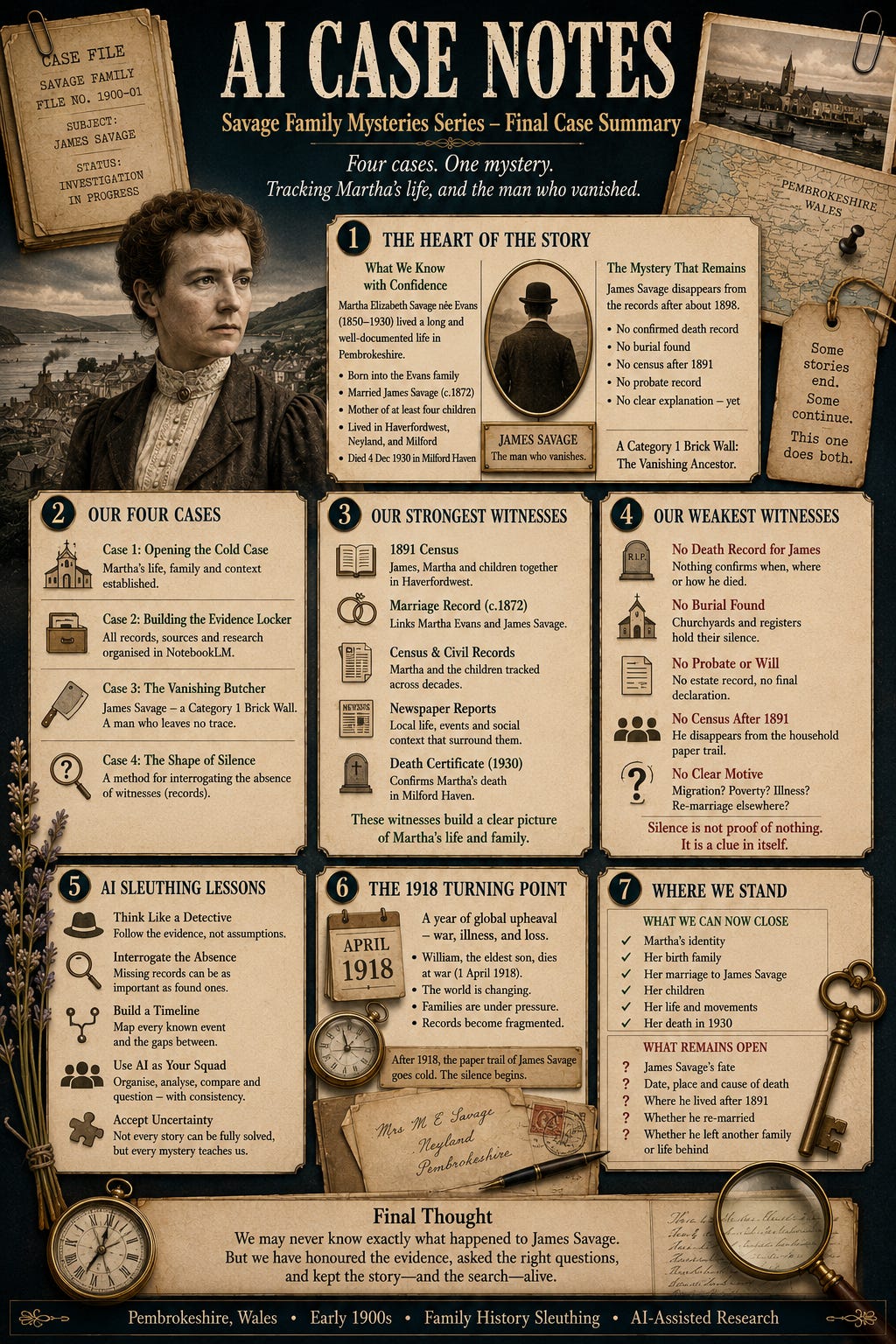
Note: time slip in posting #5 due to health issues. Here are the other episodes in order:
Opening a Cold Case June 30
Redrawing the Border July 7
The Vanishing Butcher July 14
The Shape of Silence July 21
The case began with a name and very little else. James Savage — a butcher, a husband, a father — who married in the spring of 1899, held his newborn son in the autumn of 1904, and then slipped out of the record entirely. No death we can point to. No 1911 census line. No grave beside his wife. Just an absence, shaped exactly like a man.
Over four instalments we have chased that absence across two countries and forty years of paper. This final note is not about one missing document. It is about what the whole case tells us when we lay every witness on the table at once — and about what it still refuses to tell us.
The people behind the paper
Start with Martha, because she is the one the records keep coming back to.
Martha Elizabeth Evans was born near Narberth in Pembrokeshire around 1880. She married James at Towcester in 1899, a quiet non-Anglican ceremony far from the sea she was born beside. By 1901 she was keeping house at 25 Blacksmith’s Lane in Farnborough, Warwickshire, in the middle of a butchering family that had made its living from the trade for two generations. In 1904 she registered the birth of her only son, Thomas Hugh, from her parents’ farm at Trefloyne. By 1911 she was a laundry maid in a grand house at Clydach, sixty miles from that farm, listing herself as married while her boy grew up with his grandparents. In May 1918 she was found in the sea off Gillat Point, between Tenby and Caldey. The coroner recorded a death during temporary insanity. She was buried at Penuel Baptist, Manorbier, among her own Evans people.
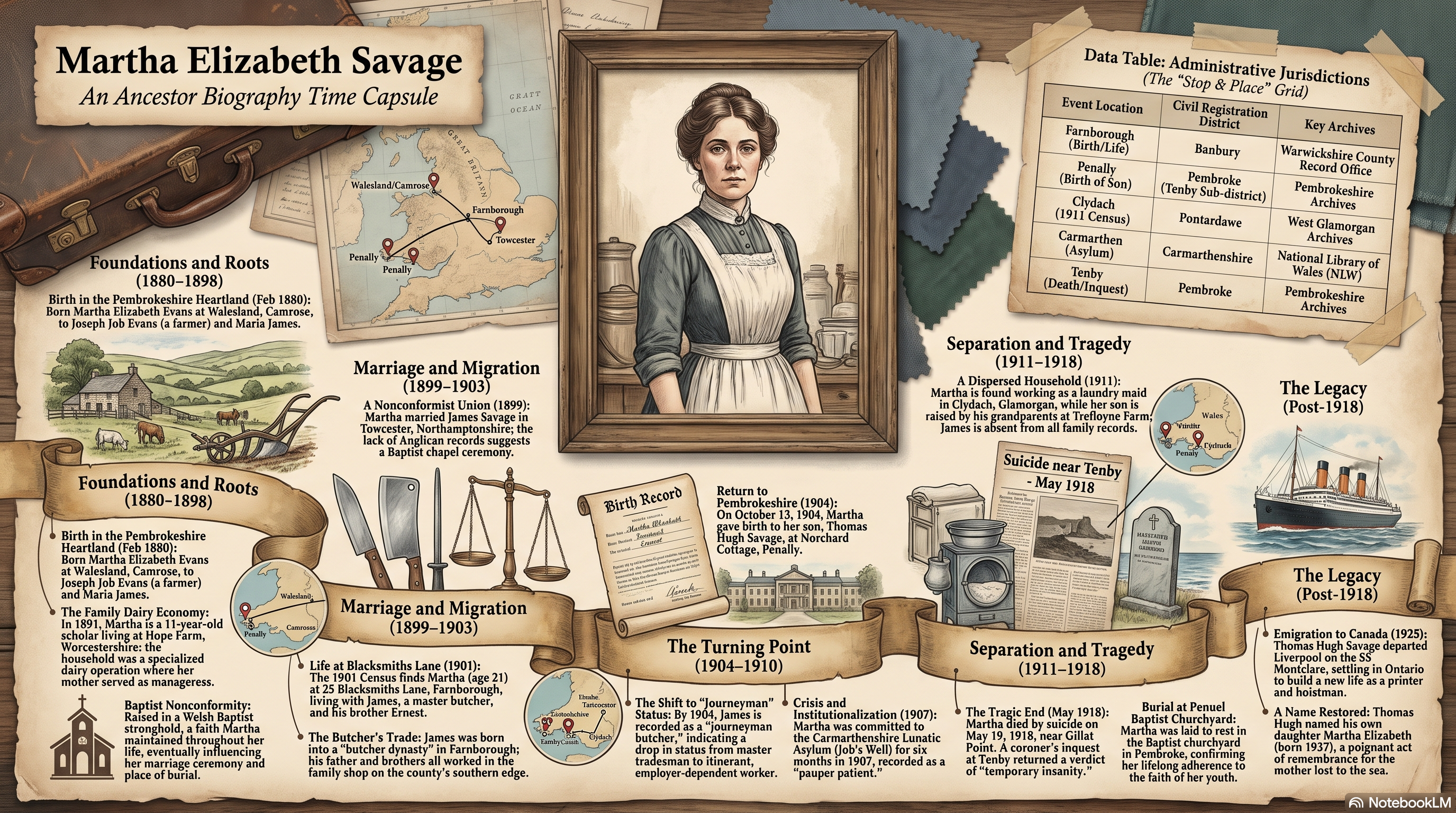
Time Capsule created by Gemini Notebook from the Evidence Locker
That is a life told almost entirely through other people’s paperwork, and it deserves to be read with care rather than curiosity.
And then there is James. The trail went cold after the 1901 census. He is there — solid, employed, ordinary — and then he is not. Present at his son’s birth in 1904 as “butcher, journeyman.” Absent from every family-linked record after it.
The evidence did not shout. It whispered.
We have never had a single document that cracks this case open. What we have is a line-up of quieter witnesses, and part of the discipline of this series has been weighing how much each one is allowed to say.
Some speak clearly. James’s 1878 birth certificate and the 1881, 1891 and 1901 censuses build an unbroken paternal line back through a Warwickshire butchery dynasty — Henry the father, a shop full of sons, James the youngest of them. The 1904 birth certificate and the 1925 passenger list bracket his son’s whole English chapter. These are strong, and they agree with one another.
Others we have had to hold more loosely. A 1907 asylum admission for a “Martha Savage” in Carmarthenshire may be our Martha — or may not. It is a lead, not a fact, and we have kept it labelled that way. The 1911 Clydach entry is almost certainly her, but “almost certainly” is not “proven,” and the difference matters.
Two witnesses joined the file only in this final round, and both earned their place. A consolidated research summary finally stated, plainly, what we do and do not know about James’s whereabouts in 1911. And a General Register Office death certificate — Entry 47 — confirmed details an earlier AI-generated case file had asserted without ever showing its source.
A word about the research squad
Because this is, after all, a series about doing genealogy with AI, it is worth naming where the tools ran ahead of the evidence — and where catching them mattered.
More than once, a confident summary turned out to be a hypothesis wearing a verdict’s clothes. A cottage was read as “Railway Cottage” from a filename and had to be corrected, patiently, to Norchard. An asylum register’s “16” was read as an age when it was only the day of the month. A tidy causal story — cumulative strain, a wartime shock, a fatal relapse — was offered with the language of near-certainty, when the records underneath it supported nothing so neat.
None of this is a mark against the tools. It is the whole point of them. AI is a superb generator of leads and a poor judge of its own confidence, and a genealogist’s job is to be the second thing. Every claim went back to the record. The record decided.
Note: When I looked closer at the birth certificate for Thomas Hugh Savage, the birthplace was definitely ‘Norchard,’ not ‘Morchard.’ I posed that hypothesis to Gemini and then opened up a new line of enquiry—aiming to find out who rented this cottage. The Old Ordnance maps clearly show this location, so I could add that to the evidence locker.
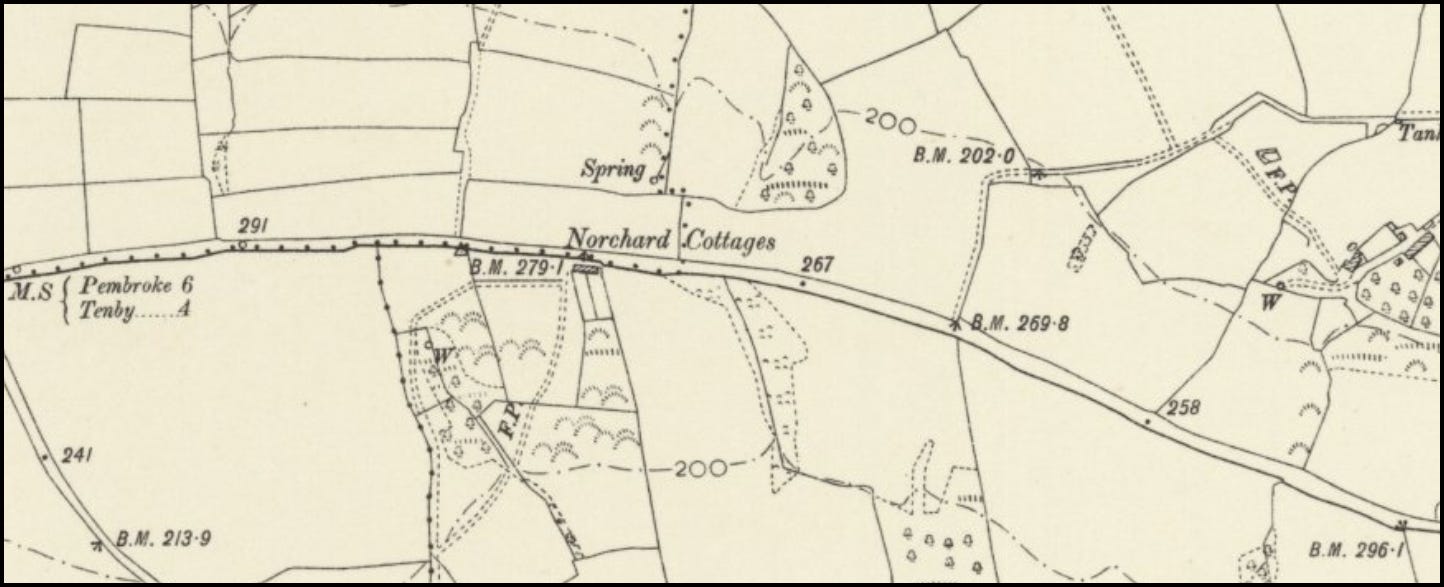
Norchard Cottages from Places, Library, Wales.
The turning point
If this final chapter has a breakthrough, it is a small, sad, decisive one.
Martha’s 1918 death certificate describes her, in the registrar’s hand, as the “Wife of James Savage, Farmer & Butcher.” Set that beside her own 1911 declaration—married, not widowed—and something shifts. Two independent voices, seven years apart, place James among the living in 1918. One by one, the records began to line up against the idea that he died young and toward a harder truth: that he was alive and elsewhere, while his family came apart without him.
Was it plausible that bad news had travelled to the Treffloyne farm (or even directly to Martha before she returned to her parents’ home) that triggered her mental state and caused her to jump into the waters at Gillat Point in the early hours of the morning of May 19, 1918?
Gemini had this to say:
Working Hypothesis
Core Premise: Martha’s suicide on May 19, 1918, resulted from a severe mental health breakdown brought on by prolonged abandonment (1904) and financial strain, decisively triggered in May 1918 while visiting Treffloyne by an external shock regarding James Savage.
A fresh lead, pointed out by Gemini as it transcribed the death certificate for Martha, gave me the direction to contact the Pembrokeshire Archives for access to the coroner’s report. I had glossed over that single fact listed in one small line on the death certificate—the coroner’s inquest was held on 20th May, but Gemini pulled that detail in.
I still await a response on this report to finally determine the reason for her dramatic action and possibly a fresh lead on James. It even hands us a fresh thread to pull. “Farmer and butcher” is not “journeyman butcher.” It hints at a man who became his own master somewhere – a business that might yet be findable in a Pembrokeshire trade directory.
Claude Cowork had this to say:
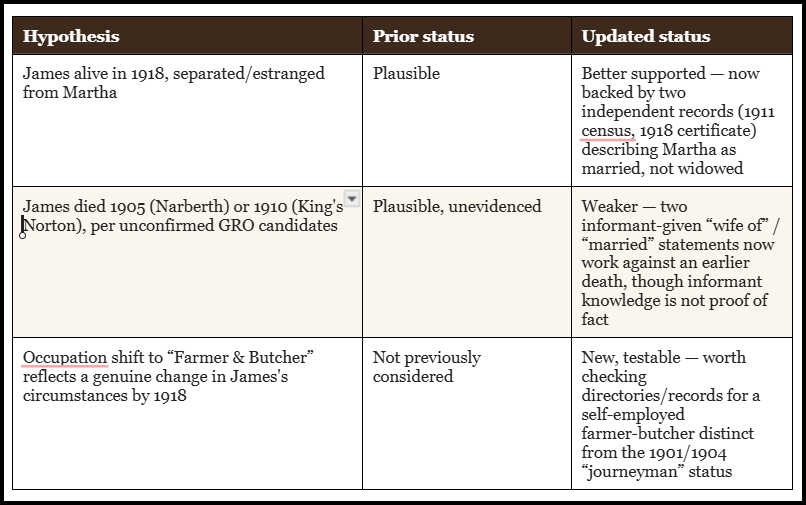
Updated Hypothesis Weighting
The certificate shifts—without settling—the balance between the two leading hypotheses about James.
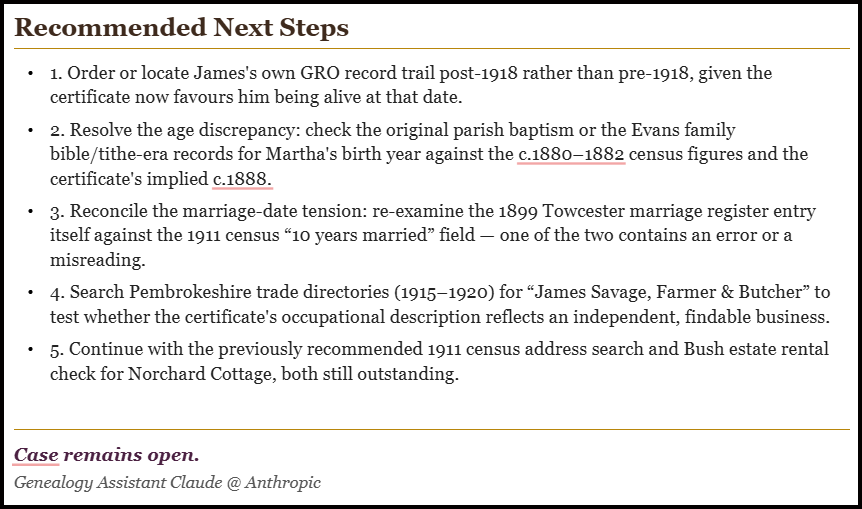
Where it stands
So what can we close, and what must we leave open?
We can close the lineage. We can close the shape of the story: a family that dispersed after 1904, a mother in service, a son with his grandparents, and a father gone. We can close Martha’s chapter with the dignity the records allow—a Pembrokeshire woman, a mother, remembered in stone beside her family.
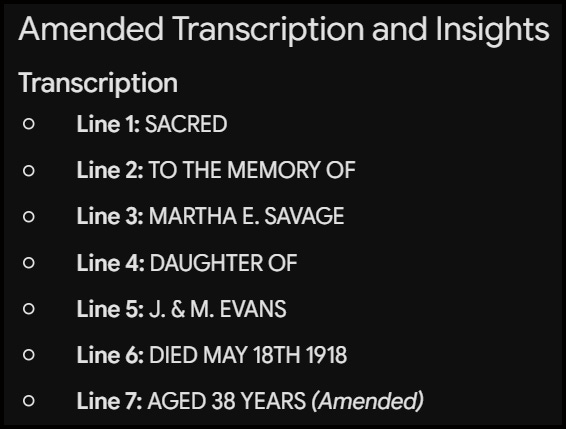
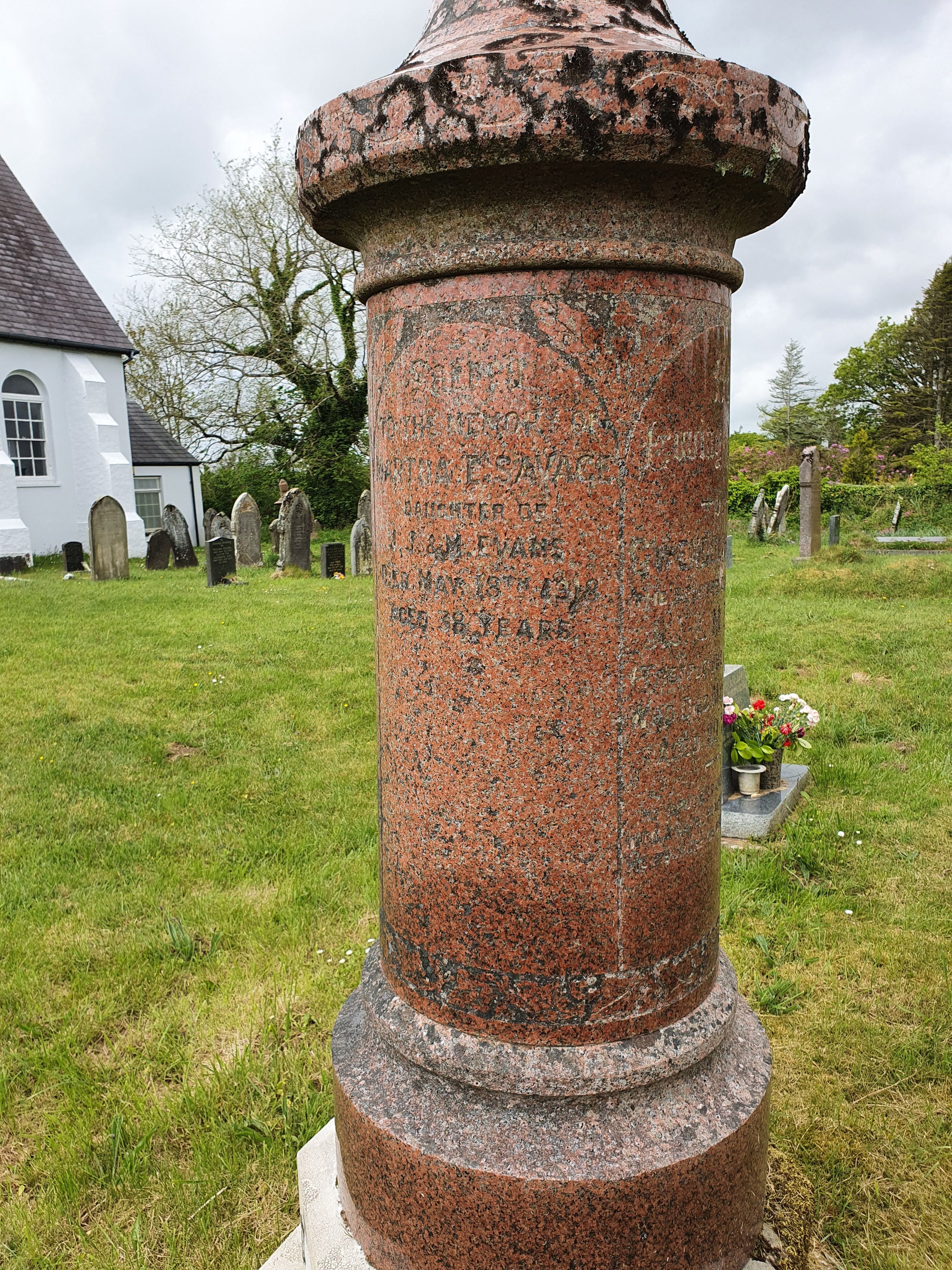

What we cannot close is James himself. We still do not know where he stood in 1911 or where and when his own life ended. We cannot yet reconcile the ages the records give Martha, nor the marriage date that two documents count differently, nor the identity of the woman admitted to that asylum in 1907. The answer was not found in a single document, but in the pattern—and the pattern, honest as it is, still has a hole in the middle of it shaped like a vanished man.
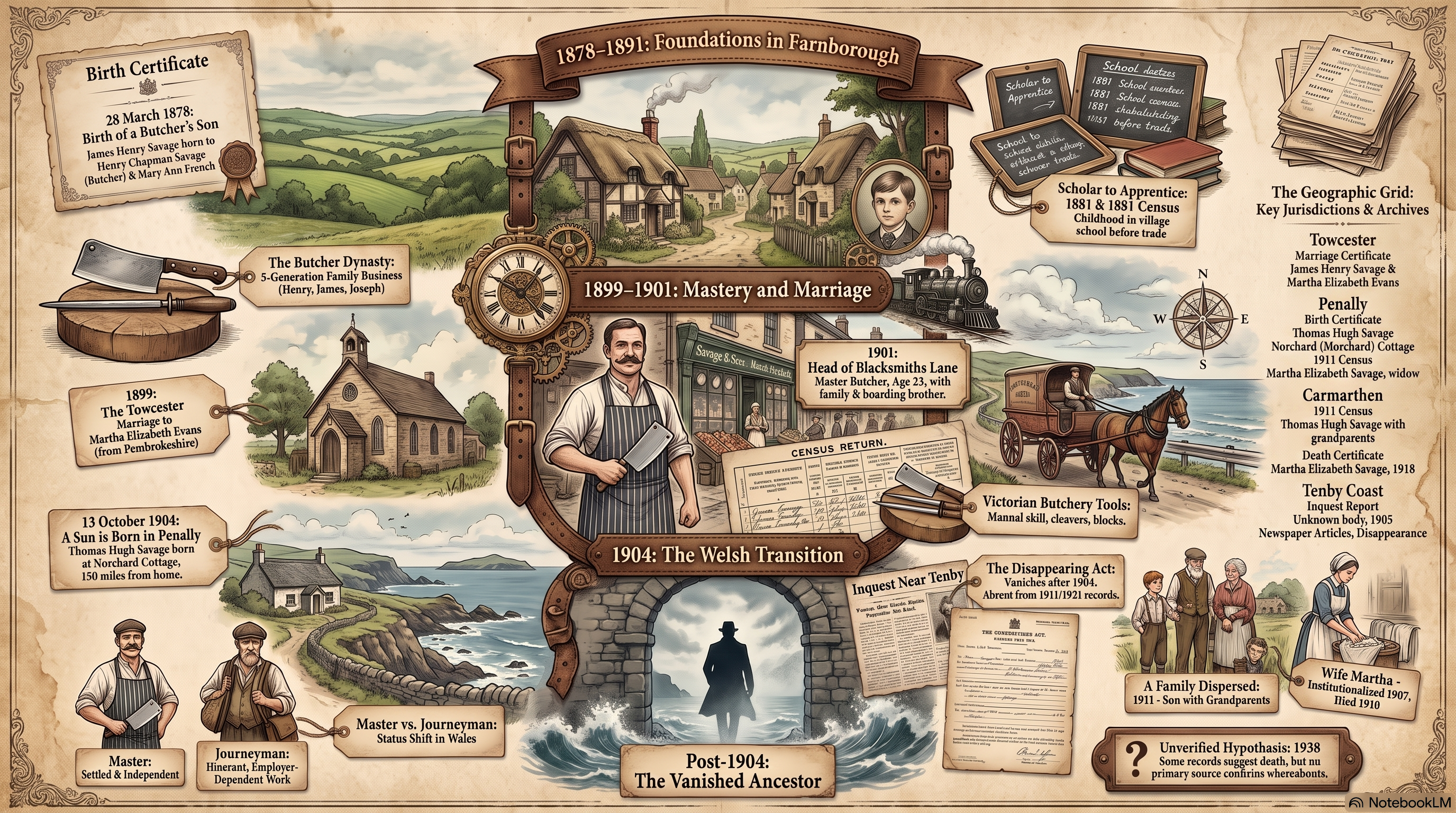
Time Capsule created by Gemini Notebook from the Evidence Locker
That is not a failure. It is the truthful state of a real case. Some families give up their secrets all at once. This one is giving up its secrets slowly and asking us to be patient.
So I will leave you where every good instalment leaves off, with the record open on the table and one question for you: of all the threads still hanging — which would you prompt me to pull? If you have followed along this month, and you have a plausible hypothesis to share, please let me know.
The case remains open.
Lisa Rex of Ancestor Audit is exploring her own research challenge case across the same five weeks. You can follow along at Lisa’s AI Case Notes.
We will be posting on Tuesdays and Thursdays throughout July, and we’re both excited to explore where our Substack Exchange will take us.
NextGenGenealogy is a reader-supported publication. To receive new posts and support my work, consider becoming a free or paid subscriber.
It's tempting to force the evidence into a satisfying conclusion, especially when AI offers plausible narratives, but you resisted that temptation throughout. I also appreciated your transparency about where the AI got ahead of the records. That's a lesson every genealogist can take away. Sometimes the most honest conclusion is simply, "This is where the evidence ends, for now." I hope that coroner's report gives you the next piece of the puzzle.